Networking Fridays
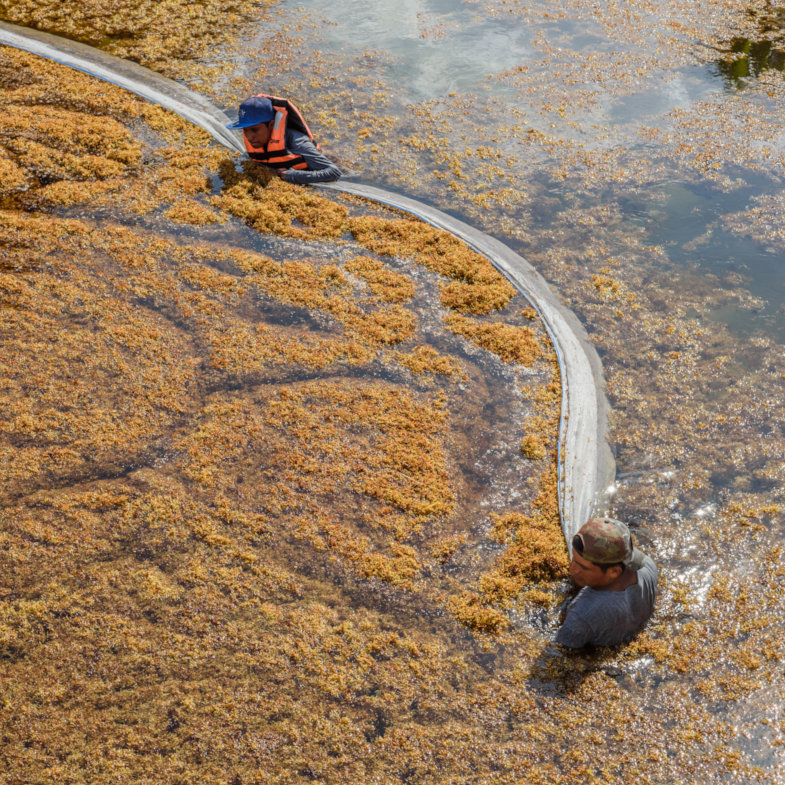
Networking Friday Special Thematic Session on Sargassum
Date
June 26, 2020, 1:00 PM - 3:00 PM UTC
AIR Centre Networking Fridays
More information about the Webinar series hereWatch the Recording
Watch on YouTube ↗Agenda:
- 1:00 PM UTC - Welcome address, introduction - Emily Smail (NOAA, GEO Blue Planet Initiative)
- 1:10 PM UTC - Tackling Sargassum in the Caribbean: A policy perspective - Cesar Toro (IOCARIBE of IOC-UNESCO)
- 1:30 PM UTC - Adapting to a new reality: Managing responses to influxes of sargassum seaweed in the Eastern Caribbean as ecosystem hazards and opportunities (SargAdapt) – Karima Degia (UWI)
- 1:50 PM UTC - Monitoring and managing impacts of Sargassum together: A basin-scale perspective – Sandra Ketelhake (AtlantOS, KDM) and Isabel Sousa Pinto (CIIMAR, GEO MBON)
- 2:10 PM UTC - Sharing information on Sargassum: the Sargassum Information Hub - Leah Mupas Segui (GEO Blue Planet)
- 2:30 PM UTC - Q&A
- 2:55 PM UTC - Closing Remarks - Emily Smail (NOAA, GEO Blue Planet Initiative)
Speakers
Cesar Toro
Tackling Sargassum in the Caribbean: A policy perspective Cesar Toro is the Head of the Subcommission for the Caribbean and Adjacent Regions IOCARIBE of the Intergovernmental Oceanographic Commission (IOC of UNESCO), based in Cartagena, Colombia. Between 2009 and 2015 he was also responsible for the UNESCO Natural Sciences Programme for the Caribbean. From IOCARIBE he has promoted the development of marine and ocean sciences and technology in the states of the region through the strengthening of institutional capacity, coordination of intergovernmental group and networks of scientists and experts. He coordinates IOC of UNESCO programmes in the Latin American and Caribbean region with those of the organizations of the United Nations system, working actively with national, regional and international agencies and entities. Cesar is a physical oceanographer, M.Sc. in oceanography and holds a Ph.D. from the University of Quebec, Canada in Physical Oceanography. Dr. Toro is a specialist in dynamical oceanography and climate change adaptation and mitigation, sustainable development and ocean governance and policy. He also has an extensive experience working for the oil and gas industry, the United Nations, and in project and programme design and implementation, especially in developing countries and SIDS.
Karima Degia
Adapting to a new reality: Managing responses to influxes of sargassum seaweed in the Eastern Caribbean as ecosystem hazards and opportunities (SargAdapt) UWI-CERMES have recently launched their SargAdapt Project (full title as captioned above). This project builds on previous work by CERMES on sargassum focused on the Eastern Caribbean. The presentation will provide an overview of CERMES previous work and outline the SargAdapt project and how it will build on what has been done thus far. SargAdapt is a project of the Caribbean Biodiversity Fund Ecosystem based Adaptation Facility with financing from the International Climate Initiative (IKI) of the German Federal Ministry for Environment, Nature Conservation, and Nuclear Safety through KfW. The project is funded primarily by a grant from the EBA Facility in the amount of USD $981,392.75 with in kind contributions from CERMES. The ultimate goal of SargAdapt is to reduce the impacts of and improve adaptation to sargassum influxes in the Eastern Caribbean with emphasis on converting a climate-linked ecosystem hazard into an asset that supports opportunities for socio-economic development. SargAdapt will be implemented over the next three years (2020-2022) with various Caribbean project partners in 5 Eastern Caribbean Countries: Dominica, St. Lucia, St. Vincent and the Grenadines, Grenada, Barbados. Karima Degia is Project Manager for CERMES SargAdapt Project, and coordinator/information manager for UWI-CERMES sargassum projects and activities. She recently joined the CERMES team in early 2020. Karima is a Barbadian professional with over twelve (12) years of experience. She is registered professional engineer, specialised in coastal engineering, with continuing education certification in sustainable environmental management. Her professional experience and interests are multi-disciplinary and multi-sectoral, spanning a wide range of technical areas, including coastal zone management, blue economy development, oceanographic and coastal processes, coastal and civil engineering, ridge to reef principles in watershed management, environmental impact assessments, coastal vulnerability and hazard risk assessments, and climate change adaptations including infrastructure solutions, ecosystems-based adaptation/ coastal ecosystems rehabilitation, and hybrid grey/green solutions. In various consulting roles, Karima has worked across project life cycle, including pre-feasibility/ feasibility studies, environmental baseline studies and management plans, participatory planning and stakeholder consultation, design of coastal infrastructure or hybrid interventions, environmental and social impact assessments, construction and implementation, implementation phase monitoring and evaluation as well as post-construction and/or post-execution monitoring, and evaluation and analysis of lessons learned. The majority of Karima’s projects have been explicit climate change adaptations or have incorporated climate change considerations.
Sandra Ketelhake
Observing, understanding, predicting and managing Sargassum together: A basin-scale perspectiveAccumulation and decay of sargassum on beaches is impacting coastlines in the Caribbean, Americas, and West Africa – causing losses of millions in the tourism industry, affecting the health of residents, and impacting the environment. Challenges for addressing this issue include: Coordination of existing oceanographic activities related to Sargassum; Access to free, open and easily understandable monitoring and forecasting products for society; knowledge about the biological and ecological impacts of the increased Sargassum; Solutions for the collection, disposal or use of sargassum biomass in a sustainable way.
The AtlantOS program together with its partners is working on the enhancement of joint observational elements in the Atlantic Ocean to improve the basin-scale system and its information products. To implement an All-Atlantic Ocean Observing System, the AtlantOS program is supporting topic related use cases with specific thematic foci that showcase the added value of a more integrated ocean observing system. This presentation will address how to tackle the challenges of bringing together different observing and modelling communities to improve the understanding, predicting and management of the increased Sargassum at the basin-scale level.
Sandra Ketelhake (M.A.) is a Science-Policy Adviser at the German Marine Research Consortium (KDM) and the Joint Programming Initiative Healthy and Productive Seas and Oceans (JPI Oceans). Her background is in international politics and international law (University of Kiel, Germany), focusing on maritime policy and the Law of the Sea. Her work now focuses mostly on ocean observing related topics like science for Good Environmental Status and the implementation of the All-Atlantic Ocean Observing System (AtlantOS). She is the German G7 National Focal Point of the Future of the Seas and Oceans Working Group. As Early Career Ocean Professional (ECOP), she is looking forward to contributing to the implementation of the UN Decade of Ocean Science for Sustainable Development (2021-2030) and is closely connected to the IOC-UNESCO UN Decade ECOP Informal Working Group. Her main interest is in assessing and showcasing the added-value of ocean observing activities in the Atlantic Ocean to achieve a sustained and comprehensive basin-scale observing system as one component of the overall system.
Isabel Sousa Pinto
Observing, understanding, predicting and managing Sargassum together: A basin-scale perspective Isabel Sousa Pinto has a PhD in Marine Biology (phycology) from the UCSB, USA. She is a Professor at the University of Porto and Head of the Aquatic Biodiversity and Conservation group at Interdisciplinary Centre for Marine and Environmental Research (CIIMAR). She is also member of its Board of Directors. Her main research has been on marine biodiversity and ecosystem functioning, and how is impacted by climate change, invasive species and other anthropogenic drivers. She has a particular focus on the seaweed flora as well as on algal ecophysiology, cultivation and promotion of its sustainable use and was member of the POGO working group “Planning the implementation of a global long-term observing and data sharing strategy for macroalgal communities”. She is also working on the science-policy – society interfaces and on promoting ocean literacy. She is serving in different European and International steering Committees as Euromarine, European Ocean Observation System (EOOS) and AtlantOS to develop the biodiversity component of the Ocean Observations and its integration with the other observation components and with the European Marine Board in to identify gaps in biological observations and produce recommendations to fill them. At global level she is the co-chair of MBON – Marine Biodiversity Observation Network from GEO BON. She was part of the Portuguese delegation to the Convention on Biological Diversity (2006-2011) and has been since working with IPBES – the Intergovernamental Panel on Biodiversity and Ecosystem Services, was the Portuguese Representative in this platform until 2018, when was elected to its Multidisciplinary Expert Panel, a panel that supervises the scientific work of the Platform, becoming later also co-chair of its Knowledge and Data task force. Besides more than 180 scientific publications, she was a Coordinating Lead Author for the Regional Assessemnt of Biodiversity and Ecosystem Services in Europe and Central Asia of IPBES.
Leah Mupas Segui
Sharing information on Sargassum: the Sargassum Information Hub Member states of the IOC Sub-Commission for the Caribbean and Adjacent Regions (IOCARIBE) requested an integrated approach to monitoring concentrations of sargassum, stronger connections with the sargassum community of practice, guidance on best management practices for sargassum events, and a centralized location for all this information. GEO Blue Planet, IOCARIBE of IOC-UNESCO, AtlantOS, and the Atlantic International Research Centre (AIR Center) developed the Sargassum Information Hub to provide information about sargassum in the Tropical Atlantic to improve communication among stakeholders and increase visibility of sargassum activities. The Sargassum Information Hub is part of a larger project to support an integrated approach to monitor and forecast concentrations of sargassum based on publicly available data, such as satellite and in-situ data, from countries with open data sharing policies and promote best practices for managing and using sargassum. Leah Mupas Segui is a 2020 John A. Knauss Marine Policy Fellow in the National Oceanic and Atmospheric Administration (NOAA) Satellite Oceanography and Climatology Division. Her current work, with the GEO Blue Planet Initiative Secretariat in College Park, Maryland, USA, supports international frameworks and their use of Earth observations data in global monitoring, mitigation, and management of marine pollution, disaster risk, and fisheries. Leah received her Ph.D. in Zoology from Oregon State University and her B.S. in Biology from San Diego State University. Her academic background focused on bridging the gap between empirical and theoretical ecology to understand how species interactions affect the structure and dynamics of marine and freshwater ecological communities.Moderator