Networking Fridays
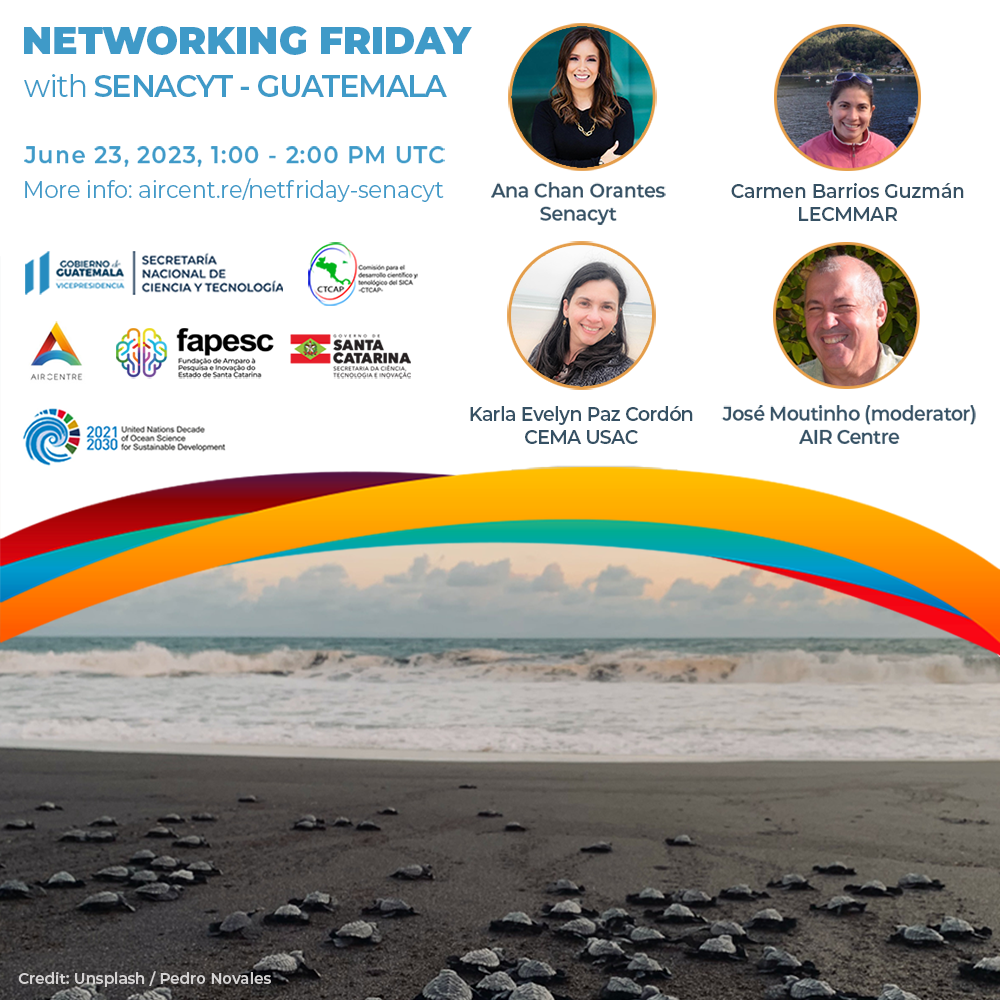
Networking Friday with SENACYT - GUATEMALA
Date
June 23, 2023, 1:00 PM - 2:00 PM UTC
AIR Centre Networking Fridays
More information about the Webinar series hereWatch the Recording
Watch on YouTube ↗- Biodiversity and conservation (biotrade, ecosystems, biodiversity, and fisheries).
- Climate change (adaptation, mitigation, monitoring and evaluation)
- Land use planning (comprehensive risk management, infrastructure).
- Technology transfer
- Science diplomacy
- Investment in research & development
- Mentoring of researchers and capacity development
- Coordination mechanisms to work on strategies to face the global challenges of innovation and competitiveness
- Diagnosis of local research capacities, skills and competences
- Exchange of experiences and research mobility
Programme
- 1:00-1:05 - Opening remarks, José Moutinho, Chief Business & Networking Officer at the AIR Centre
- 1:05-1:15 - Welcome address and introduction to the Heroines in Science Programme, Ana Chan Orantes, National Secretary of Science and Technology of Guatemala
- 1:15-1:35 - Progress in the monitoring of the marine stressor Harmful Algal Blooms (HAB) in the Pacific of Guatemala, Karla Evelyn Paz Cordón, University of San Carlos of Guatemala.
- 1:35-1:55 - Unlocking Insights into Marine Ecosystems, Carmen Barrios Guzmán, University of Valparaiso.
- 1:55 - 2:00 - Q&A moderated by Jose Luiz Moutinho
- 2:00 - Closing.
Speakers
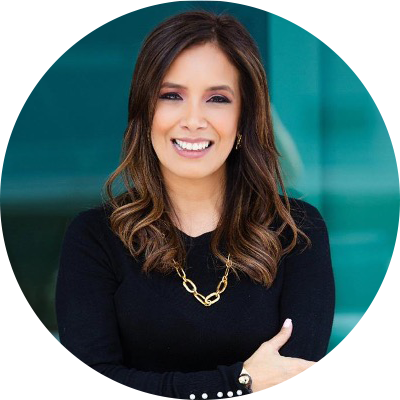
Ana Chan Orantes
Ana Chan Orantes is the National Secretary of Science and Technology of Guatemala. During her tenure at the National Secretariat of Science and Technology of Guatemala (Senacyt), she has promoted strategic actions to bring science closer to society, such as the National Alliance for the Development of Science, Technology and innovation (CTi) as the dissemination project of the CTi with a territorial approach and the strategy for the inclusion of women and indigenous peoples in the CTi. Ana Chan Orantes promoted the creation of spaces to make visible the work of women scientists from Guatemala and to encourage more women and girls to venture into scientific areas. She promoted the processes of modernisation and institutional strengthening to improve the efficiency and transparency in the management of Senacyt and in the access to the funds under its responsibility. Ana Chan Orantes strengthened the dialogue with the different actors that make up the National System of Science and Technology (SINCYT). She represented Guatemala in high-level international forums such as: CELAC, CTCAP (which is a Copernicis Node), IAI, CYTED, COMCYT, OEA, among others. Ana Chan Orantes has a Master Degree in International Law, and she isa Lawyer, a Notary, and a certified arbitrator. She was the recipient of a Mashav Scholarship from the Israelian Government (shot bio in Spanish here).
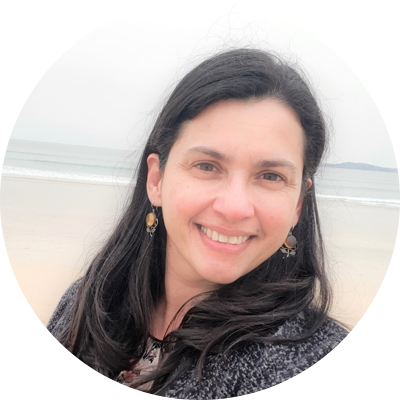
Karla Evelyn Paz Cordón
Progress in the monitoring of the marine stressor Harmful Algal Blooms (HAB) in the Pacific of Guatemala In Guatemala, plankton studies have been related to events of food poisoning due to the consumption of bivalves. The historical events reported begin in August 1987 on the Pacific coast of Guatemala, where 193 cases of human poisoning due to shellfish consumption were reported, of which 22 were fatal. The organism causing the poisoning was identified as Pyrodinium bahamense var. compressum, a species of microalgae that produces a paralysing toxin. This microalgae was reported again in an algal bloom in November 2019 on the Pacific coast of Guatemala and in the epidemiological alert between April 29 and May 20, 2022, when 34 cases of human intoxication were reported, of which 4 were fatal. Harmful algal blooms (HAB) is a marine stressor characterised by the increase in biomass of toxin-producing microalgae that has negative effects on ecosystems, human health, fishing, and tourism. In Guatemala, there is constant effort for monitoring microalgae in the central Pacific and providing basic information on the identification of the species. One of the objectives is to identify the species not yet addressed and propose improvements in monitoring and research activities that can not only increase our knowledge about the complexity of the HAB on Guatemala's coasts, but also help integrating new institutions in this effort. Karla Evelyn Paz Cordón is a teacher with more than 20 years of experience at the Center for Studies of the Sea and Aquaculture of the University of San Carlos de Guatemala, where She teaches courses on aquatic zoology, biology, aquatic ecology and aquatic botany. She is a member of the Hydrobiological Research Institute of CEMA, where she is coordinator of the Plankton program, researching in topics related to marine ecology and identification and quantification of plankton. She also participates as Marine Stressor Coordinator: Harmful Algal Blooms and Marine Toxins in the Research Network of Marine-Coastal Stressors in Latin America and the Caribbean (REMARCO); Representative of Guatemala before the IOCARIBE of IOC UNESCO; and Representative of Guatemala before the project: Carmina: Diversity and toxicity of microalgae associated with ciguatera in the Caribbean area, with NOOA and IFREMER. Karla Evelyn Paz Cordón is a writer of educational material on aquatic science topics and she is very interested in scientific dissemination for which she participated in the USAID Inspiring Women program on the topic "Women who jump into the water". She is currently in his last year in the Doctoral Program in Agricultural and Environmental Sciences from the University of Santiago de Compostela, Spain. Karla Evelyn Paz Cordón has received several awards during her academic career, including on from the Institute University for Women (IUMUSAC) for being the first woman graduated with a degree in Aquaculture.
Carmen Barrios Guzmán
To gain a comprehensive understanding of marine ecosystems and the interactions between individual consumers and these systems, it is crucial to consider the complex interplay of physicochemical and biological factors across diverse spatial and temporal scales. However, assessing these factors on a large scale is often logistically complex, expensive, and time-consuming. Therefore, an alternative approach is to employ proxy measures, such as stable isotope values in biological materials, to assess the spatial and temporal variations of these factors along coastlines and ocean basins. By analysing stable isotopes, it becomes possible to determine the relative contributions of different prey items to a consumers diet, identify the habitats utilised by these consumers, track the significance of primary energy sources that sustain food webs, and even uncover animal migration routes. The isotopic composition of marine animal tissues varies, reflecting geographic differences in diet and water chemistry. When these spatial variations are known or predictable, tissue isotopic compositions can infer an animal's origin, assess feeding areas, detect dietary changes, and analyse migratory patterns. This approach provides valuable insights into the structure and functioning of marine ecosystems and their capacity to respond to environmental changes.
Carmen Barrios Guzmán is a researcher at the Laboratory of Ecology and Conservation of Marine Mammals (LECMMAR) at the University of Valparaiso, Chile. She has a Ph.D. in Science specialising in Aquatic Natural Resources from the University of Valparaiso and a MSc. in Aquaculture and Fisheries (UAlg). Carmen Barrios Guzmán has conducted studies in environmental education and sustainable tourism, ecology and behaviour of sea lions, assessment of marine pollution using marine mammals as sentinels, and interaction of marine mammals with anthropogenic activities.Moderator
José Moutinho
José Moutinho is a Biologist, with a bachelor’s degree in Zoology, graduated from the Federal University of Rio de Janeiro in 1981; Architect, graduated from Santa Ursula University in Rio de Janeiro, in 1988, with equivalence conferred by the Faculty of Architecture of the Technical University of Lisbon in 1989; Master of Science in Engineering and Technology Management from the Institute of Innovation, Technology and Development Policie (IN+) of Instituto Superior Tecnico (IST) in 2005. Currently he is the Chief Business & Network Officer for the Atlantic International Research Centre (AIR Centre). Jose Moutinho is Coordinator of the BlueMissionAA CSA, Co-leader of the All-Atlantic Marine Research Infrastructure Network (AA-MARINET); Co-chair of the Steering Committee of the GEO Blue Planet Initiative; Member of the Atlantic Strategy 2.0 Task Force Pillar IV: Healthy ocean and resilient coasts; and Associate member of the International Ocean Colour Coordinating Group (IOCCG) Task Force on Remote Sensing of Marine Litter and Debris.
We will continue with the Networking Fridays during the next months. More information about future sessions as well as presentations and videos from previous sessions can be found here. Twitter Hashtag: #netfridays. Expect some very exciting afternoons, or mornings or evenings, depending on where you are… If you need any additional information please send an email to Jose Luiz Moutinho. Marine Biodiversity Networking Fridays | MAELSTROM: Marine Litter and Biodiversity: Co-detection and impact, dedicated to marine litter and biodiversity, focusing on current scenarios and future challenges. Networking Friday with Konstantinos Topouzelis with Cesar Toro (UAEGEAN), who presented “Fighting the ocean plastic pollution with the use of satellite images and drone data: Plastic Litter Project (PLP), history and future steps”. The moderator was Leah Mupas Segui, who had just started a new position with the Pew Charitable Trusts as part of their Preventing Ocean Plastics research team. Networking Friday with Maria Buraimoh (University of Lagos, Nigeria), who presented "Circular Economy: A Sustainable And Preventive Strategy For The Alleviation Of Atlantic Ocean Pollution". The moderator was Isa Elegbede, Faculty of Environment and Natural Sciences, Brandenburg University of Technology (BTU), Germany.