A sustainable blue economy is based on information and knowledge. Knowledge about marine biodiversity is fundamental to managing and conserving ecosystem services. Historically, decisions about living resources and ocean uses have often been based on physical data such as temperature, bathymetry, and perhaps chemical observations.
Emerging technologies now make it possible to incorporate biology and ecology routinely into ocean surveys and monitoring programs at local and regional scales. Advances in standardization of data formatting and storage, in open databases, will allow critical regional to global assessments about how biodiversity is changing and why. Best practices allow for measurements and other information to be interoperable, incomparable, scalable, and implementable by local groups and nations.
This session promotes the integration of biological and ecological observations into coastal and ocean observing systems and monitoring programs. An increase in coordination, capacity development, and implementation efforts is required in the standardization or at least interoperability in the collection, analysis, and delivery of biodiversity observations.
In this session, experts and stakeholders will review co-design strategies conducted under the Marine Life 2030 Programme of the Ocean Decade, including the Marine Biodiversity Observation Network (MBON) and regional elements of the Global Ocean Observing System (GOOS). It will also consider monitoring and management projects and programs in order to develop indicators and support decision-making about marine ecosystem services and nature-based solutions for climate change mitigation. The goal is to better manage ocean uses and satisfy national reporting requirements for targets of Sustainable Development Goals, the post-2020 Convention on Biological Diversity, and other national and international frameworks.
We provide a space for meaningful dialogue between stakeholders, seeking collaborations to conserve and conduct responsible use of the oceans for sustainable development (SDG14).
Terminal de Cruzeiros do Porto de Leixões
Av. General Norton de Matos s/n
4450-208 Matosinhos
(+351) 22 340 18 27
Isabel Sousa Pinto
ispinto@ciimar.up.pt
Susana Moreira
smmoreira@ciimar.up.pt
Palácio das Laranjeiras, Estrada das Laranjeiras 205
1649-018 Lisboa, Portugal
(+351) 911 985 924
José Luiz Moutinho
jose.moutinho@aircentre.org
Joana Soares
joana.soares@aircentre.org
1315 East-West Highway 2nd Floor
Silver Spring, MD 20910
(240) 533-9452
Gabrielle Canonico
gabrielle.canonico@noaa.gov
Anna Zivian
azivian@oceanconservancy.org
College of Marine Science
St. Petersburg, Florida 33701, USA
Frank Muller-Karger
carib@usf.edu
 Workshop
 Forum
Forum
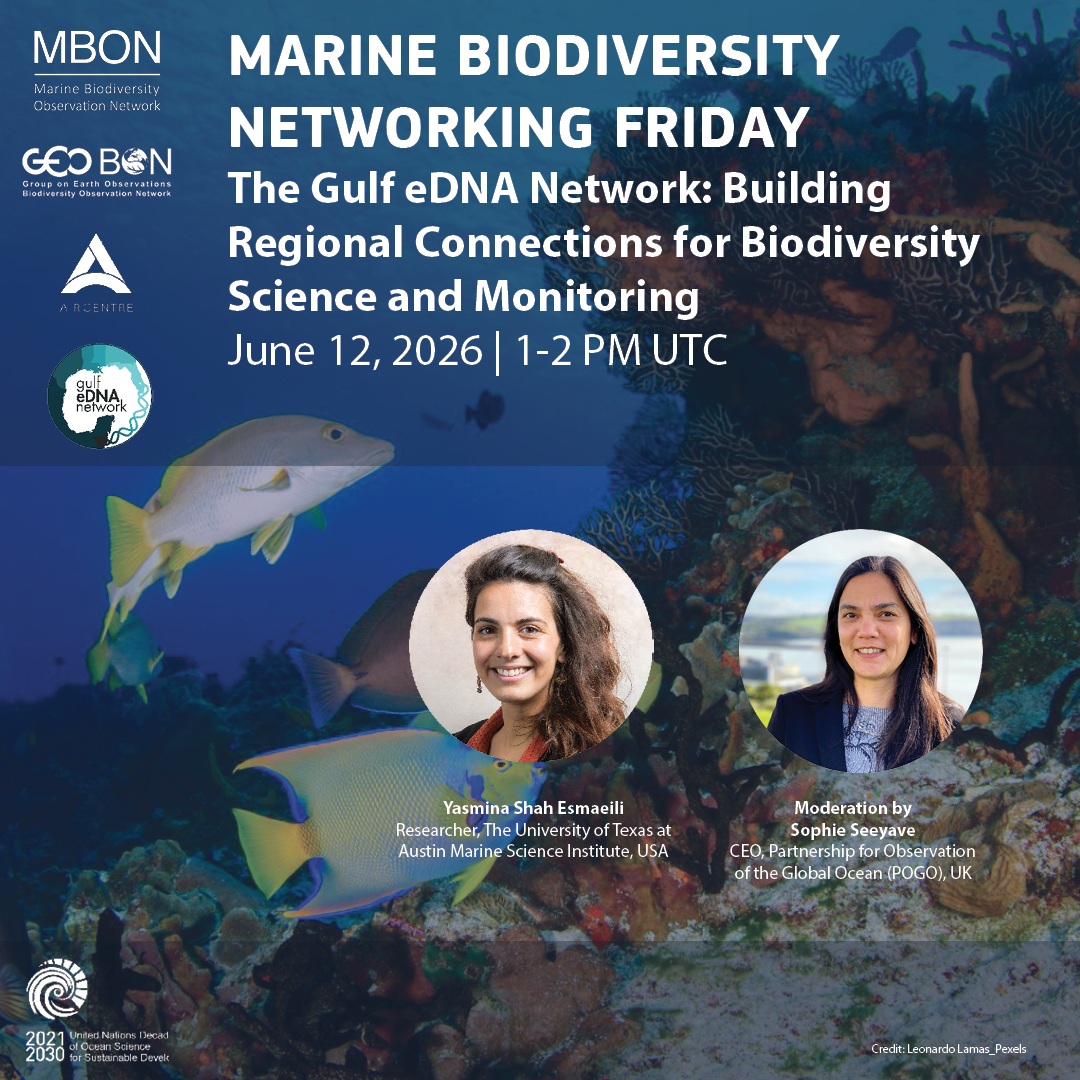 Networking Friday