ESAPlastics – De-Risk Action: Spectrometer for Marine Litter
A De-Risk Action evaluating and developing prospective spectrometer technology for marine litter detection from space, partially funded by ESA's General Support Technology Programme (GSTP).
PROJECT DESCRIPTION
\n \n
\n \n
\nINESC Technology and Science – INESC TEC is an Associate Laboratory with more than 30 years of experience in R&D and technology transfer. It is a private non-profit research institution having as associates the University of Porto, INESC and the Polytechnic Institute of Porto. With around 800 researchers (350 PhD), works in the interface between the academic world and the industrial and service companies, as well as the public administration. The activity at INESC TEC runs under the paradigm of the knowledge to value production chain: knowledge and results generated at basic research are typically injected in technology transfer projects and therefore they receive added social relevance. The existence of an Innovation and Technology Transfer Unit assures the effectiveness of this model. INESC TEC incorporates 13 R&D Centres and one Associate Unit with complementary competences, always looking to the international market.
\n
\nThe main contributions from INESC TEC to this project will be made by the Centre for Robotics and Autonomous Systems (CRAS) and the Centre for Applied Photonics (CAP).CRAS conducts research and development activities in autonomous robotic systems, mobile robotics and mobile multi-robot systems for inspection, monitoring and mapping, with applications in security, power systems, environment, aquaculture, oceanography, marine biology, resource extraction, among other sectors. These activities are supported by the research in perception, navigation, control, localization, coordination, and automatic data collection and processing. CAP detains long experience with lasers, spectroscopy and optical sensors.
\n
\n
\n
\n
\n
\nINESC Technology and Science – INESC TEC is an Associate Laboratory with more than 30 years of experience in R&D and technology transfer. It is a private non-profit research institution having as associates the University of Porto, INESC and the Polytechnic Institute of Porto. With around 800 researchers (350 PhD), works in the interface between the academic world and the industrial and service companies, as well as the public administration. The activity at INESC TEC runs under the paradigm of the knowledge to value production chain: knowledge and results generated at basic research are typically injected in technology transfer projects and therefore they receive added social relevance. The existence of an Innovation and Technology Transfer Unit assures the effectiveness of this model. INESC TEC incorporates 13 R&D Centres and one Associate Unit with complementary competences, always looking to the international market.
\n
\nThe main contributions from INESC TEC to this project will be made by the Centre for Robotics and Autonomous Systems (CRAS) and the Centre for Applied Photonics (CAP).CRAS conducts research and development activities in autonomous robotic systems, mobile robotics and mobile multi-robot systems for inspection, monitoring and mapping, with applications in security, power systems, environment, aquaculture, oceanography, marine biology, resource extraction, among other sectors. These activities are supported by the research in perception, navigation, control, localization, coordination, and automatic data collection and processing. CAP detains long experience with lasers, spectroscopy and optical sensors.
\n
\n
\n
\n \n
\nThe AIR Centre is an internationally networked organization, oriented to foster job creation and knowledge-driven sustainable economic development in Atlantic regions. It addresses and integrates space, climate, earth, ocean, energy and data sciences and promotes north-south/south-north/north-north/south-south cooperation in alignment with national/regional priorities and global challenges such as the UN 2030 Agenda for Sustainable Development, the Decade of Ocean Science for Sustainable Development (2021-2030), the Paris Agreement and the Sendai Framework for Disaster Risk Reduction.
\n
\nThe AIR Centre is all about advancing science and technology in a transformative scale in the Atlantic region. It builds on and expands the abilities of individual organizations, and it advances selected scientific and technological domains and their constellations of actors towards shared targets. For that, it recruits and orchestrates a complex web of organizations and individuals to deliver change and social impact through concrete actions.
\n
\nThis complexity comes from the AIR Centre’s unique multidimensional mission-oriented, demand-driven, problem-solving approach, which integrates various sciences (space, ocean, earth, climate, energy, and data sciences), includes different stakeholders (government, academia, industry, and civil society), encompasses diverse geographies, cultures and technology readiness levels (American, African, European countries and small island states or territories in the Atlantic region), and fully accommodates both local priorities and global challenges.
\n
\n
\n
\n
\n
\nThe AIR Centre is an internationally networked organization, oriented to foster job creation and knowledge-driven sustainable economic development in Atlantic regions. It addresses and integrates space, climate, earth, ocean, energy and data sciences and promotes north-south/south-north/north-north/south-south cooperation in alignment with national/regional priorities and global challenges such as the UN 2030 Agenda for Sustainable Development, the Decade of Ocean Science for Sustainable Development (2021-2030), the Paris Agreement and the Sendai Framework for Disaster Risk Reduction.
\n
\nThe AIR Centre is all about advancing science and technology in a transformative scale in the Atlantic region. It builds on and expands the abilities of individual organizations, and it advances selected scientific and technological domains and their constellations of actors towards shared targets. For that, it recruits and orchestrates a complex web of organizations and individuals to deliver change and social impact through concrete actions.
\n
\nThis complexity comes from the AIR Centre’s unique multidimensional mission-oriented, demand-driven, problem-solving approach, which integrates various sciences (space, ocean, earth, climate, energy, and data sciences), includes different stakeholders (government, academia, industry, and civil society), encompasses diverse geographies, cultures and technology readiness levels (American, African, European countries and small island states or territories in the Atlantic region), and fully accommodates both local priorities and global challenges.
\n
\n
\n
\n \n
\nThe Institute of Marine Research (IMAR) was created with a mission to "conduct leading deepsea and open ocean research and education to advance the understanding of marine systems in a changing planet, and promote the sustainable blue economy and management of marine ecosystems for the benefit of the society and the environment". IMAR develops both fundamental and applied research with many international partners from around the world, and promotes strong links with governmental and private organizations, and with the society as a whole.
\n
\nIMAR is a leading national research centre on marine sciences recently affiliated to the MARE Marine and Environmental Sciences Centre. IMAR currently includes 31 PhD Integrated Members, 54 regular members (technicians, junior researchers, and students), and various collaborating members. IMAR activities are directed to scientific research and education on the ecology, ecosystem functioning, and ecosystem based management of open ocean and deep-water marine ecosystems, including seamounts, hydrothermal vents, mid-ocean ridges, abyssal plains, and the pelagic and mesopelagic realms, with a special focus on the Atlantic Ocean but with extensions to other ocean basins.
\n
\nIMAR has contributed profoundly, and will keep contributing to the sustainable management of the oceans at the local, national, european, and international levels though a dedicated agenda which promotes the transfer of scientific knowledge to governmental and private organizations, and to the society. IMAR has also paid special attention to improving ocean literacy and environmental awareness.
\n
\n
\n
\nThe Institute of Marine Research (IMAR) was created with a mission to "conduct leading deepsea and open ocean research and education to advance the understanding of marine systems in a changing planet, and promote the sustainable blue economy and management of marine ecosystems for the benefit of the society and the environment". IMAR develops both fundamental and applied research with many international partners from around the world, and promotes strong links with governmental and private organizations, and with the society as a whole.
\n
\nIMAR is a leading national research centre on marine sciences recently affiliated to the MARE Marine and Environmental Sciences Centre. IMAR currently includes 31 PhD Integrated Members, 54 regular members (technicians, junior researchers, and students), and various collaborating members. IMAR activities are directed to scientific research and education on the ecology, ecosystem functioning, and ecosystem based management of open ocean and deep-water marine ecosystems, including seamounts, hydrothermal vents, mid-ocean ridges, abyssal plains, and the pelagic and mesopelagic realms, with a special focus on the Atlantic Ocean but with extensions to other ocean basins.
\n
\nIMAR has contributed profoundly, and will keep contributing to the sustainable management of the oceans at the local, national, european, and international levels though a dedicated agenda which promotes the transfer of scientific knowledge to governmental and private organizations, and to the society. IMAR has also paid special attention to improving ocean literacy and environmental awareness.
\n
\n
Summary
\nThis De-Risk Action will evaluate and develop at a low TRL, prospective technology that in the future can lead to the development of a spectrometer for marine litter detection from space. Clearly there is an opportunity to develop innovative technology that can take advantage of Earth Observation satellite constellations to provide a continuous monitoring of earth oceans and coastal areas. \n \nMarine litter is considered a global problem, and if no change occurs in the near future it will be even bigger by the end of 2030. Therefore this De-Risk activity will follow a two-step technical approach: \n-
\n \t
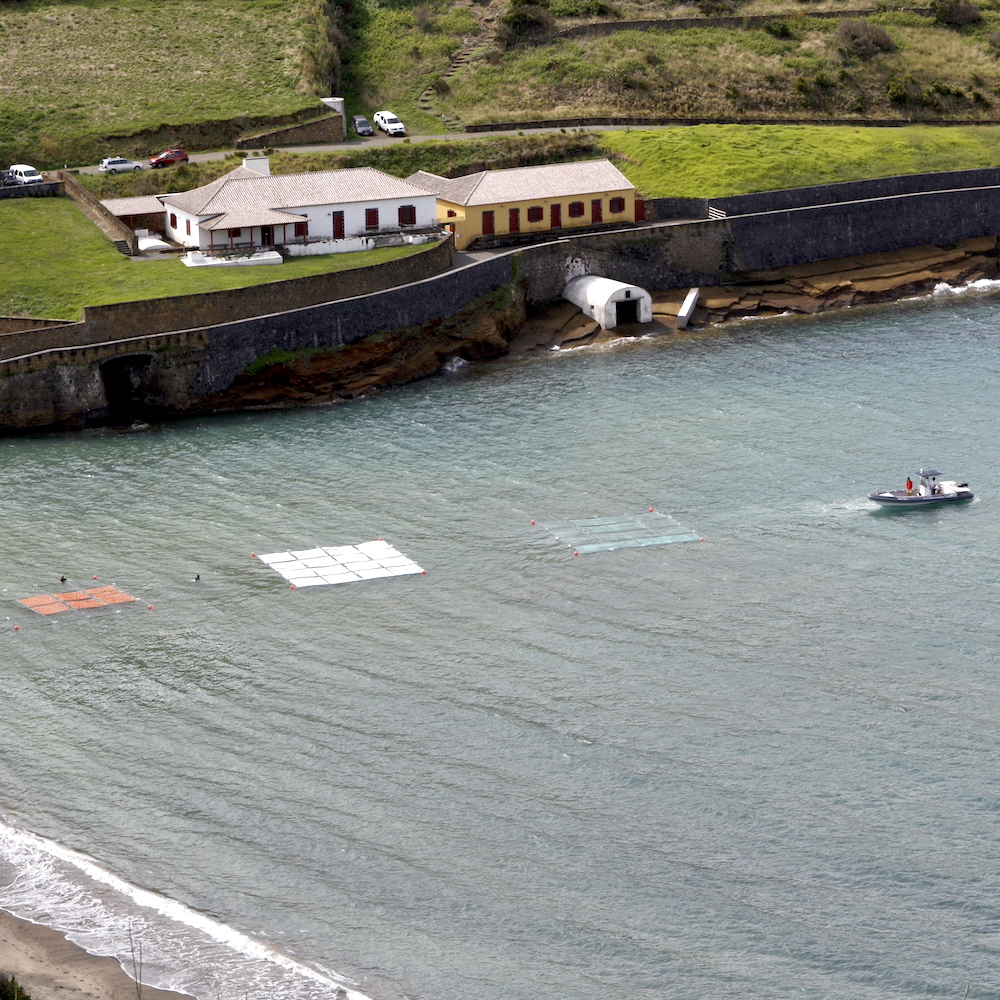
- Acquisition of reliable marine litter data, using heterogeneous sensors (visible cameras, multispectral cameras, hyperspectral cameras in the VNIR and SWIR range) located at different altitudes, and using different systems, namely: satellite PRISMA and Sentinel 2 information, Unmanned Aerial Vehicles (UAV) and manned aircraft. \n \t
- Processing of such information, leading to two valuable outcomes; one is machine learning methods to help classify marine litter using artificial intelligence (AI) in post processing; the other, the theoretical assessment and evaluation of compressive sensing techniques using tailored spectral bands, in view of its potential improved SNR, minimizing mass, volume and/or power, as a potential technique for high sensitivity satellite based plastic monitoring. \n
\nConsortium
\n
\n
\nINESC Technology and Science – INESC TEC is an Associate Laboratory with more than 30 years of experience in R&D and technology transfer. It is a private non-profit research institution having as associates the University of Porto, INESC and the Polytechnic Institute of Porto. With around 800 researchers (350 PhD), works in the interface between the academic world and the industrial and service companies, as well as the public administration. The activity at INESC TEC runs under the paradigm of the knowledge to value production chain: knowledge and results generated at basic research are typically injected in technology transfer projects and therefore they receive added social relevance. The existence of an Innovation and Technology Transfer Unit assures the effectiveness of this model. INESC TEC incorporates 13 R&D Centres and one Associate Unit with complementary competences, always looking to the international market.
\n
\nThe main contributions from INESC TEC to this project will be made by the Centre for Robotics and Autonomous Systems (CRAS) and the Centre for Applied Photonics (CAP).CRAS conducts research and development activities in autonomous robotic systems, mobile robotics and mobile multi-robot systems for inspection, monitoring and mapping, with applications in security, power systems, environment, aquaculture, oceanography, marine biology, resource extraction, among other sectors. These activities are supported by the research in perception, navigation, control, localization, coordination, and automatic data collection and processing. CAP detains long experience with lasers, spectroscopy and optical sensors.
\n
\n
\n
\n
\n
\nThe AIR Centre is an internationally networked organization, oriented to foster job creation and knowledge-driven sustainable economic development in Atlantic regions. It addresses and integrates space, climate, earth, ocean, energy and data sciences and promotes north-south/south-north/north-north/south-south cooperation in alignment with national/regional priorities and global challenges such as the UN 2030 Agenda for Sustainable Development, the Decade of Ocean Science for Sustainable Development (2021-2030), the Paris Agreement and the Sendai Framework for Disaster Risk Reduction.
\n
\nThe AIR Centre is all about advancing science and technology in a transformative scale in the Atlantic region. It builds on and expands the abilities of individual organizations, and it advances selected scientific and technological domains and their constellations of actors towards shared targets. For that, it recruits and orchestrates a complex web of organizations and individuals to deliver change and social impact through concrete actions.
\n
\nThis complexity comes from the AIR Centre’s unique multidimensional mission-oriented, demand-driven, problem-solving approach, which integrates various sciences (space, ocean, earth, climate, energy, and data sciences), includes different stakeholders (government, academia, industry, and civil society), encompasses diverse geographies, cultures and technology readiness levels (American, African, European countries and small island states or territories in the Atlantic region), and fully accommodates both local priorities and global challenges.
\n
\n
\n
\n
\n
\nThe Institute of Marine Research (IMAR) was created with a mission to "conduct leading deepsea and open ocean research and education to advance the understanding of marine systems in a changing planet, and promote the sustainable blue economy and management of marine ecosystems for the benefit of the society and the environment". IMAR develops both fundamental and applied research with many international partners from around the world, and promotes strong links with governmental and private organizations, and with the society as a whole.
\n
\nIMAR is a leading national research centre on marine sciences recently affiliated to the MARE Marine and Environmental Sciences Centre. IMAR currently includes 31 PhD Integrated Members, 54 regular members (technicians, junior researchers, and students), and various collaborating members. IMAR activities are directed to scientific research and education on the ecology, ecosystem functioning, and ecosystem based management of open ocean and deep-water marine ecosystems, including seamounts, hydrothermal vents, mid-ocean ridges, abyssal plains, and the pelagic and mesopelagic realms, with a special focus on the Atlantic Ocean but with extensions to other ocean basins.
\n
\nIMAR has contributed profoundly, and will keep contributing to the sustainable management of the oceans at the local, national, european, and international levels though a dedicated agenda which promotes the transfer of scientific knowledge to governmental and private organizations, and to the society. IMAR has also paid special attention to improving ocean literacy and environmental awareness.
\n
\nMedia:
\n-
\n \t
- INESC TEC and ESA will test technology to detect plastics in the sea \n \t
- Satellite can be used to detect marine debris \n \t
- INESC TEC | Economia do Mar - Spectrometer for marine litter, TSF, 31OUT2020 \n \t
- Projeto português para detetar lixo marinho financiado pela ESA \n
Contact:
\nDiana Viegas (INESC TEC) \n| Acronym | ESAPlastics |
| Title | ESAPlastics – De-Risk Action: Spectrometer for Marine Litter |