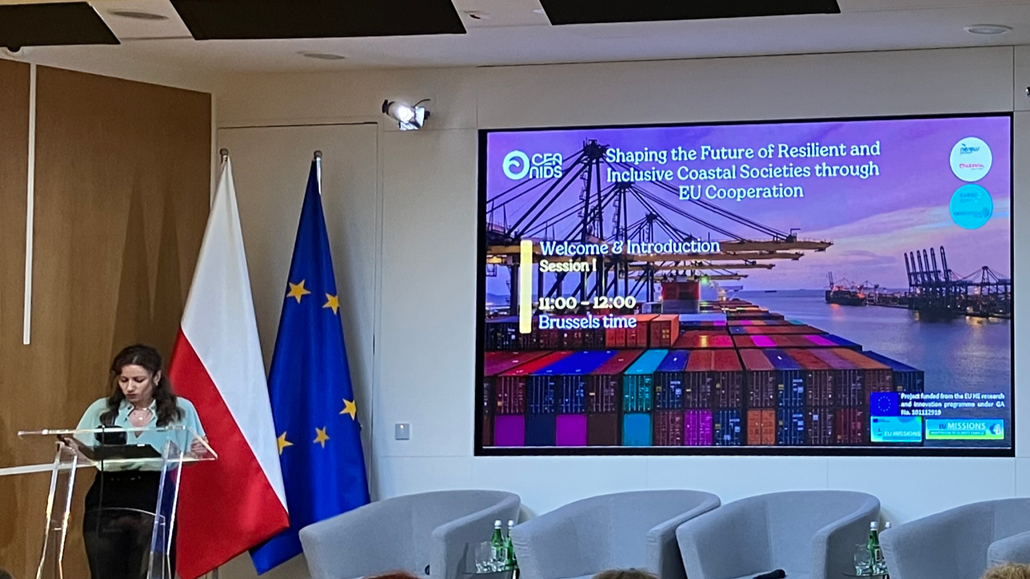
On 9 June, AIR Centre's Head of Biodiversity and Blue Economy, Natalia Ospina-Alvarez, represented the AIR Centre at the OCEANIDS Conference held at the Permanent Representation of the Republic of Poland to the European Union in Brussels.
Titled "OCEANIDS: Shaping the Future of Resilient and Inclusive Coastal Societies through EU Cooperation", the one-day conference aimed to showcase the OCEANIDS platform at EU level and engage key policy stakeholders in discussions on advancing the Blue Economy. The event brought together a high-level audience including representatives from the European Commission, the European Parliament, the Committee of the Regions, port authorities, coast guards, local and regional administrations, research institutions, and maritime sector associations.
The conference explored how Copernicus data and integrated applications can support EU citizens, regional and local authorities, and foster sustainable maritime governance. It also provided a forum for broader dialogue on research, innovation, and industrial development within the maritime sector, while demonstrating the tangible benefits of OCEANIDS tools for non-specialist stakeholders and their practical impact on Blue Economy activities.
Among the key takeaways, the conference underlined how OCEANIDS integrates Copernicus data into practical tools for climate-ready coastal planning, turns complex Earth Observation data into accessible and reusable services for maritime spatial planning, supports the EU Mission on Adaptation to Climate Change, and delivers value across a wide range of stakeholders through a shared, interoperable data infrastructure.
OCEANIDS is a Horizon Europe project focused on developing citizen-driven tools and applications for climate-informed Maritime Spatial Planning and integrated seascape management. Its central approach is to collect, harmonise, and curate existing climate data services, making them accessible, reusable, and interoperable for the development of local adaptation strategies. The project directly supports the EU Mission on Adaptation to Climate Change and contributes to sustainable Blue Economy governance across member states.
AIR Centre contributes to the OCEANIDS project as an End-User partner, bringing its expertise to shape tools that address real needs in coastal regions across Europe.
[NOA, 9 June 2026]
 Innovation