Networking Fridays
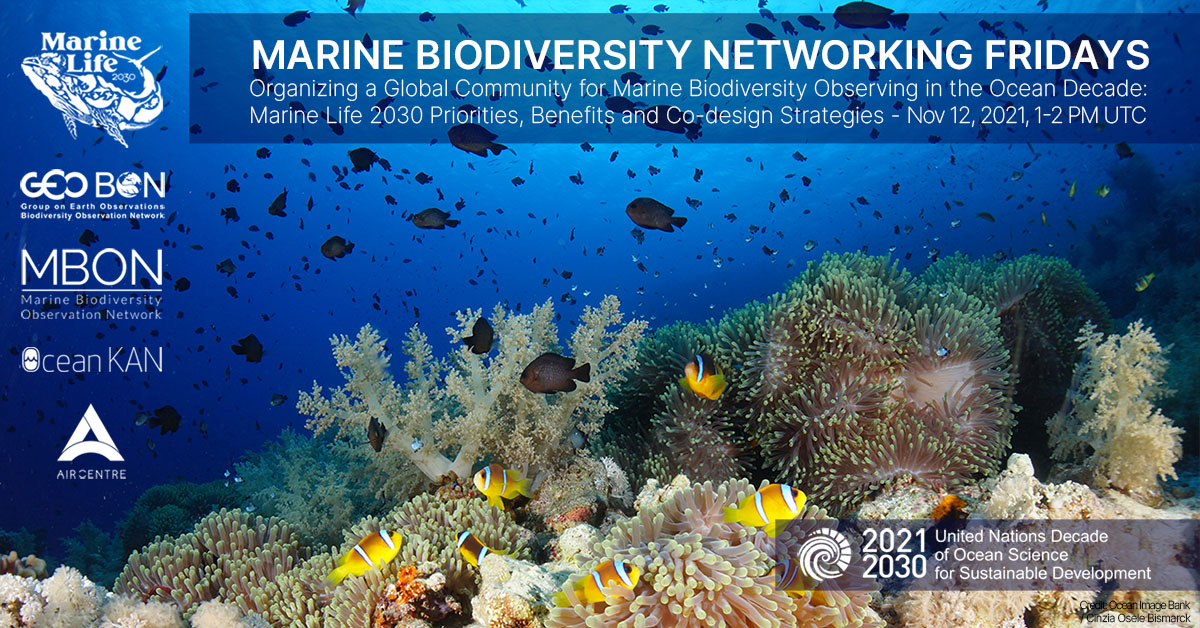
Marine Biodiversity Networking Fridays
Fecha
November 12, 2021, 1:00 PM - 2:00 PM UTC
AIR Centre Networking Fridays
Más información sobre la serie de Webinars aquíVer la Grabación
Ver en YouTube ↗On November 12th, 2021, 1-2 PM UTC, we had our very first Marine Biodiversity Networking Friday, which was brought to you by the Marine Biodiversity Observation Network (MBON) and the AIR Centre This session, MBON and the organization of a global community for the Ocean Decade: Priorities, benefits, and co-design strategies, engaged participants from 57 countries in the design of the Marine Life 2030 Ocean Decade program, including a request to contribute to the leadership of themes and tasks.
Programme:
- Welcome note, Joana Soares
- The Marine Life 2030 Ocean Decade Programme, Frank Muller-Karger
- Marine Life 2030 Website, Kristen Yarincik
- Ocean Knowledge Action Network (OKAN): Marine Life 2030 partnerships, Linwood Pendleton
- Discussion
Marine Life 2030: A Programme endorsed by the UN Decade of Ocean Science for Sustainable Development
Marine Life 2030 is a program to establish the globally coordinated system to deliver actionable, transdisciplinary knowledge of ocean life to those who need it, promoting human well-being, sustainable development, and ocean conservation. The diversity of marine habitats and species is fundamental for human survival. Biodiversity provides opportunities for multiple fisheries, the tourism industry, and harbor medicines and materials. The Marine Biodiversity Observation Network (MBON) is providing networking support for this collaboration with multiple international partners. MBON fosters collaborations to coordinate collection, sharing, and application of biodiversity information. Benefits of joining include expanded capacity to address research goals, leveraging resources and best practices; linking natural and social sciences to answer policy questions; engaging diverse and early-career researchers; and addressing issues of concern to humanity.
Ocean Knowledge Action Network (Ocean KAN): Marine Life 2030 partnerships
The Ocean Knowledge-Action Network (Ocean KAN) is an initiative currently sponsored by the Scientific Committee on Oceanic Research (SCOR) of the International Science Council (ISC), Future Earth, World Climate Research Programme (WCRP) and the Intergovernmental Oceanographic Commission of UNESCO (IOC-UNESCO). To meet the goals of sustainable development, we need to ensure that science and technology are designed to be useful for those who need it to plan and make decisions for a sustainable future. The Ocean KAN will create a modern, hybrid network of networks around Marine Life 2030 and related programs that makes best use of human and digital assets in a process known as Network Weaving. In Phase 1, we will innovate by working across different digital platforms and accommodates different cultural approaches. The Ocean KAN will work to include stakeholders and decision makers in the co-creation and co-design of ocean science for the Ocean Decade.
Relevant Links:
- Marine Life 2030 Website
- Marine Life 2030 Sign-Up for Tasks and Activities
- Explore The Ocean Decade Actions
If you want to be part of Marine Life 2030, please contact:
Speakers
Joana Soares
Joana Soares is an Ecotoxicologist, who presently is the Executive Secretary of the Marine Biodiversity Observation Network (MBON) of the Group on Earth Observations Biodiversity Observation Network (GEO BON) and a Project Officer at Earth Observation Laboratory of the Atlantic International Research Centre (AIR Centre). Soares, J. has graduated in Aquatic Sciences in 2005 and holds a Ph.D. in Biomedical Sciences since 2014, both from ICBAS-University of Porto. She has a solid research background in Ecotoxicology and Endocrine disruption, as well as a strong experience in molecular biology and toxicogenomics. Her research focused on the hazard assessment of endocrine disruptors and contaminants of emerging concern, and the correlation with the chemical’s underlying mechanisms of action, using integrative analysis of endpoints for a more accurate evaluation of contaminant's effects and risk of exposure (embryotoxicity, behavior analysis, molecular biomarkers, modeling). The derivation of ecotoxicity factors and the development of guidelines for aquatic environmental risk assessment have also been a topic of her work. Addressing global changes, in an integrative approach to space, climate, and ocean in the Atlantic, focusing on marine biodiversity conservation, are emergent topics of her work. Over the years she has gathered experience in the training of undergraduate and master´s students, has also been a jury for master´s and doctoral theses; in the scientific proposals writing; in peer review of scientific articles in several international journals; in writing international scientific articles (ORCID ID: https://orcid.org/0000-0002-7105-2815; SCOPUS AUTHOR ID: 56498014300).
Frank Muller Karger
Marine Life 2030: A Programme endorsed by the UN Decade of Ocean Science for Sustainable Development Frank Muller-Karger is a biological oceanographer who researches the diversity of life in the sea, factors that drive diversity and production, and the relevance to people. He combines traditional oceanographic methods and satellite remote sensing to study patterns of variation of phytoplankton and coastal wetlands. He is involved in several international working groups including the Marine Biodiversity Observation Network (MBON, as co-chair) of GEO BON, the UNESCO Intergovernmental Oceanographic Commission’s (IOC) Global Ocean Observing System (GOOS) Bio-Eco panel, the UNESCO IOC’s Ocean Best Practices Steering Committee, and leads the OceanObs Research Coordination Network (RCN).
Linwood Pendleton
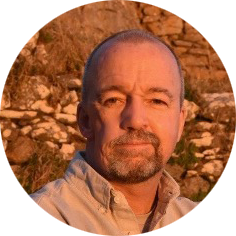
Ocean Knowledge Action Network (Ocean KAN): Marine Life 2030 partnerships Linwood Pendleton will introduce the Ocean Knowledge Action Network, its hybrid digital-human approach to building a network of networks, and will describe how it is working with Marine Life 2030 to create the relationships and processes to catalyse the co-design of ocean biodiversity science and data collection for sustainable development Linwood is the Executive Director of the Ocean Knowledge Action Network, hosted in France. He holds the International Chair of Excellence at the European Institute for Marine Studies. He was a member of the Executive Planning Committee of the UN Decade of Ocean Science for Sustainable Development and now serves on the interim Decade Advisory Board. Linwood has broad experience in marine conservation science with degrees in biology (William and Mary), ecology/evolution/behavior (Princeton), public administration (Harvard), and environmental economics (Yale). His work, both in academia and the real world, incorporates all of these fields and more. Linwood served as the Global Lead for Ocean Science at the World Wild Fund for Nature, was the Acting Chief Economist for the National Oceanic and Atmospheric Administration from 2011-2013, and is an Adjunct Associate Professor at the Duke University Marine Laboratory. He has also collaborated with conservation organizations worldwide including WWF, The Nature Conservancy, Environmental Defense Fund, NRDC, and he served for nearly ten years on the Board of the Conservation Strategy Fund. He currently serves on the MarineGeo Advisory Council and the Marine GEOBON RCN. We will continue with the Networking Fridays during the next months. More information about future sessions as well as presentations and videos from previous sessions can be found here. Please do not forget to subscribe to our YouTube Channel. Twitter Hashtag: #netfridays. Expect some very exciting mornings, afternoons or evenings, depending on where you are… If you need any additional information please send an email to Jose Luiz Moutinho. Networking Friday with Argyro Kavvada (NASA), who reviewed innovative Earth observation solutions for the Sustainable Development Goals. This session was moderated by Samy Djavidnia. Networking Friday Special Thematic Session on Evolving and Sustaining Ocean Best Practices with Jay Pearlman, Pier Luigi Buttigieg, Rachel Przeslawski, Juliet Hermes, and Alison Clausen. this session was moderated by Frank Muller-Karger Networking Friday Special Session on Sargassum with Cesar Toro (IOCARIBE of IOC-UNESCO), Karima Degia (UWI), Sandra Ketelhake (AtlantOS, KDM), Isabel Sousa Pinto (CIIMAR, GEO MBON), and Leah Mupas Segui (GEO Blue Planet Initiative). The moderator was Emily Smail (NOAA, GEO Blue Planet Initiative).
Ponentes
Joana Soares
Frank Muller Karger
Linwood Pendleton